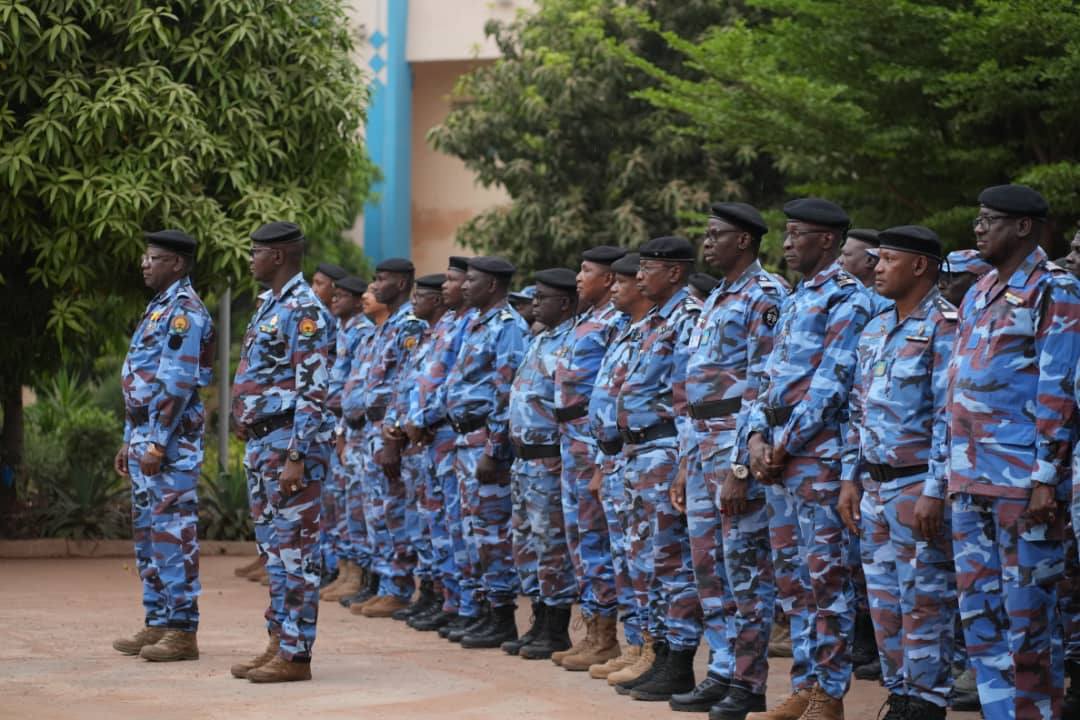
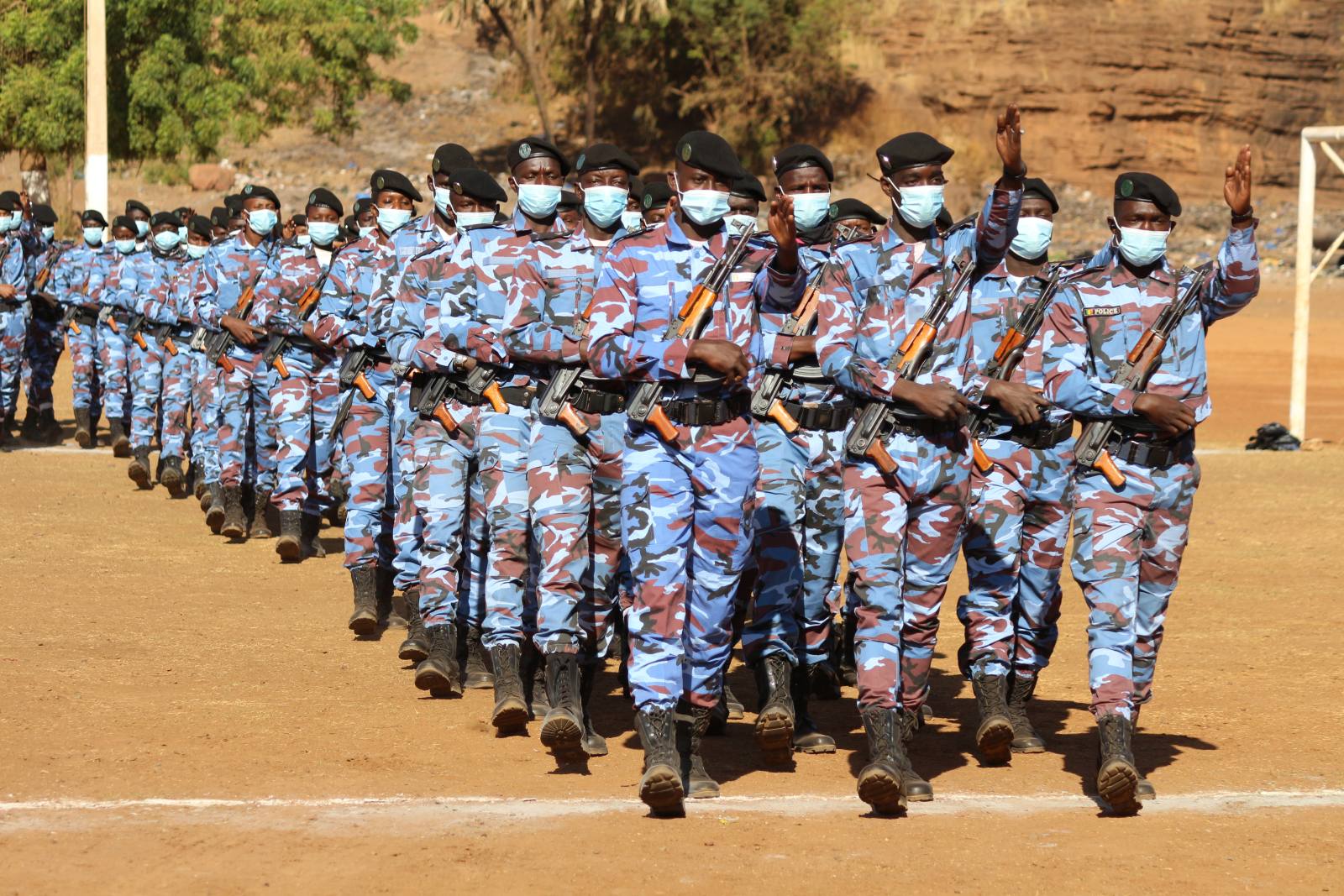
National Police officers on duty
National institution

Directorate General of the National Police

Guarantor of public freedoms and of the security of institutions, the National Police works every day for social peace and the protection of citizens throughout Malian territory.

Heritage & Modernity

A force serving the Republic

Heir to a long tradition of service to the State, the National Police has evolved to meet today's security challenges: cybercrime, terrorism, border protection and the maintenance of public order.

Serve with honour, protect with dedication.
Facade and institutional presence of the National Police
24/7 Availability
+50 Police stations
100% Commitment
Our history

Milestones of the institution

From its creation to its present organisation, the National Police has adapted to the demands of each period in the history of Mali.

1925 - 1960

Birth of the Malian Police

The Malian Police came into being in 1925. At its creation, its staff consisted of civil servants divided among six corps. During the colonial period, people from French Sudan held only junior posts in the Police, namely in the corps of assistants and police constables. It was not until the framework law (known as the Gaston Defferre law) of 1956 that the first Black person held the office of police commissioner, at the Railway Authority. In June 1959, Mr Mahamane TOURE was appointed Deputy Director of the Sûreté. A revolution at the time! Mahamane TOURE remained in office until the departure, on 4 October 1960, of Divisional Commissioner Morette ELYSEE, the last Frenchman to head the Police. On 15 February 1961, Mr Oumar BORE was appointed Director of the Security Services of the Republic of Mali. From independence onwards, four stages can be distinguished in the history of the Police.

  • Police commissioners
  • Police officers
  • Deputy police officers
  • Police inspectors
  • Police assistants
  • Police constables
1960 - 1973

Building the Republic

In the aftermath of Independence, the Police came under the general civil service statute and was attached to the Ministry of the Civil Service, Labour and Social Affairs. From June 1968, the Police changed status and became semi-military, with four corps: Police Commissioners (category A), Police Officers (category B), Police Inspectors (category C) and Guardians of the Peace (category D). With this change, the police unions (the General Confederation of Labour (CGT) and Force Ouvrière (FO)) were dissolved. With the military coup of November 1968 and the appointment of Lieutenant Tiékoro BAGAYOKO as head of the Police, it became the Directorate General of Security Services.

  • Police Commissioners
  • Police Officers
  • Police Inspectors
  • Guardians of the Peace
1973 - 1993

Gradual militarisation

From January 1973, the Police became a military corps in fact but not in law, as military titles were applied to it. The officer corps thus included Lieutenants, Captains and Majors, while the non-commissioned officer corps included Warrant Officers, Staff Sergeants and Sergeants. In 1979, the Directorate General of Security Services became the National Directorate of Police Services, then the Directorate of National Security in 1985. The 1987 statute clearly announced the militarisation of the Police, which was militarised and grouped into two corps: the officer corps and the non-commissioned officer corps. This militarisation brought the corps of Police Inspectors to an end. The Police kept its military status until 1993.

  • The 1987 statute confirms the militarisation.
  • Personnel are grouped into an officer corps and a non-commissioned officer corps.
1993 - 2002

Return to paramilitary status

The General Statute of Police Officials drawn up in February 1993 enshrined the demilitarisation of the Police. Trade unions were once again allowed within it. The new paramilitary statute set out three corps: the corps of Commissioners (category A), the corps of Inspectors (category B) and the corps of Assistants (category C). These three corps were later amended to take into account the objections of Police Cadets, who had rejected their classification in category C. In April 1994, the General Statute of Police Officials was therefore amended to include four corps: Police Commissioners (category A), Police Inspectors (category B2), Police Non-Commissioned Officers (category B1) and Police Constables (category C).

  • Police Commissioners
  • Inspectors
  • Police Non-Commissioned Officers
  • Police Constables
2002 - 2022

Modernisation of the corps

The demilitarisation of the Police was further entrenched by the General Statute of Police Officials adopted in 2002, which divides police officers into three corps instead of four: the corps of Police Commissioners, with the ranks of Inspector General of Police, Controller General of Police, Divisional Commissioner of Police, Principal Commissioner of Police and Commissioner of Police; the corps of Police Inspectors, with the ranks of Police Inspector of Exceptional Class, Divisional Inspector of Police, Principal Inspector of Police and Police Inspector; the corps of Police Non-Commissioned Officers, with the ranks of Police Major, Police Chief Warrant Officer, Police Warrant Officer, Police Staff Sergeant and Police Sergeant.

  • Corps of Police Commissioners
  • Corps of Police Inspectors
  • Corps of Police Non-Commissioned Officers
Since 2022

New militarisation

The National Police was militarised on 27 October 2022. It now comes under the general statute of military personnel, while remaining attached to the Ministry of Security and Civil Protection for deployment.

  • A change that is part of the priorities for rebuilding the State.
  • Deployment under the orders and authorisation of the CEMGA (Chief of General Staff of the Armed Forces).
Missions

Our core missions

The core missions of the National Police in the service of the Republic.

01

Protect

Protect people and property.

02

Maintain order

Maintain public order, safety, security and peace.

03

Law enforcement

Ensure that laws and regulations are respected by carrying out administrative police and criminal investigation missions.

04

Arms control

Enforce the regulations on weapons and ammunition.

05

Private services

Oversee the activities of private security companies.

06

Gaming establishments

Oversee licensed gaming establishments.

07

Air and Borders

Provide air and border policing.

08

Institutions

Help protect State institutions and senior dignitaries.

09

Information

Take part in the Government's information mission.

10

Peacekeeping

Take part in peacekeeping and humanitarian assistance operations.

11

Civil defence

Take part in civil protection and civil defence.

Ce site utilise des cookies pour mesurer l'audience et améliorer votre expérience. Vous pouvez accepter ou refuser.

En savoir plus